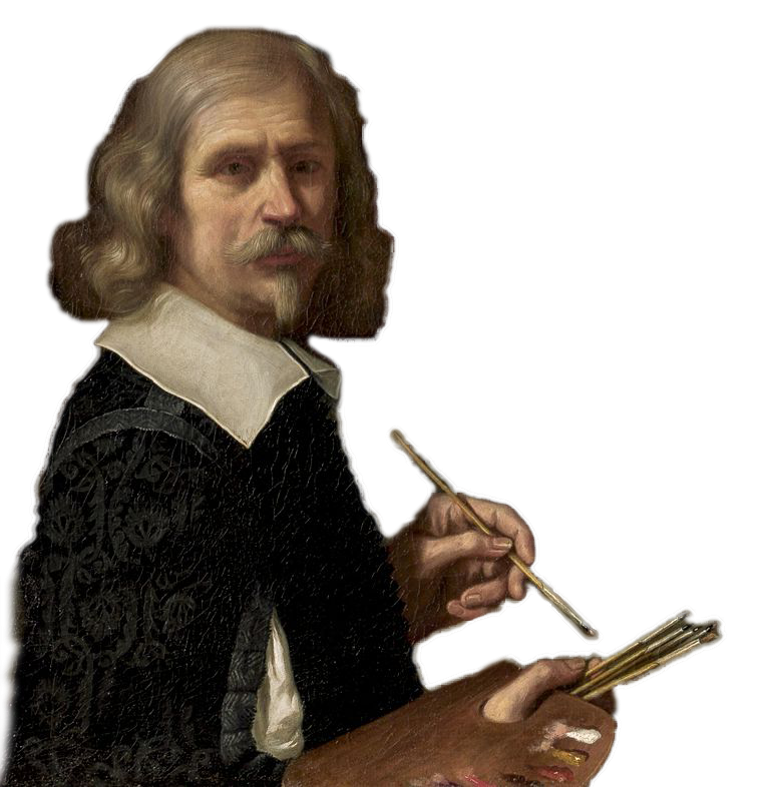



In questo contesto, il disegno rappresenta qualsiasi figura tracciata utilizzando linee grafiche, incisioni o apposizioni su un supporto. Poiché può essere realizzato con mezzi semplici, permette all’artista di sviluppare una tecnica personale e offre ampio spazio per la sperimentazione, divenendo l’espressione più diretta e sincera del suo pensiero. A seconda del livello di dettaglio e complessità, il disegno è stato descritto in vari modi nella trattatistica artistica (schizzo, abbozzo, modello, bozzetto).
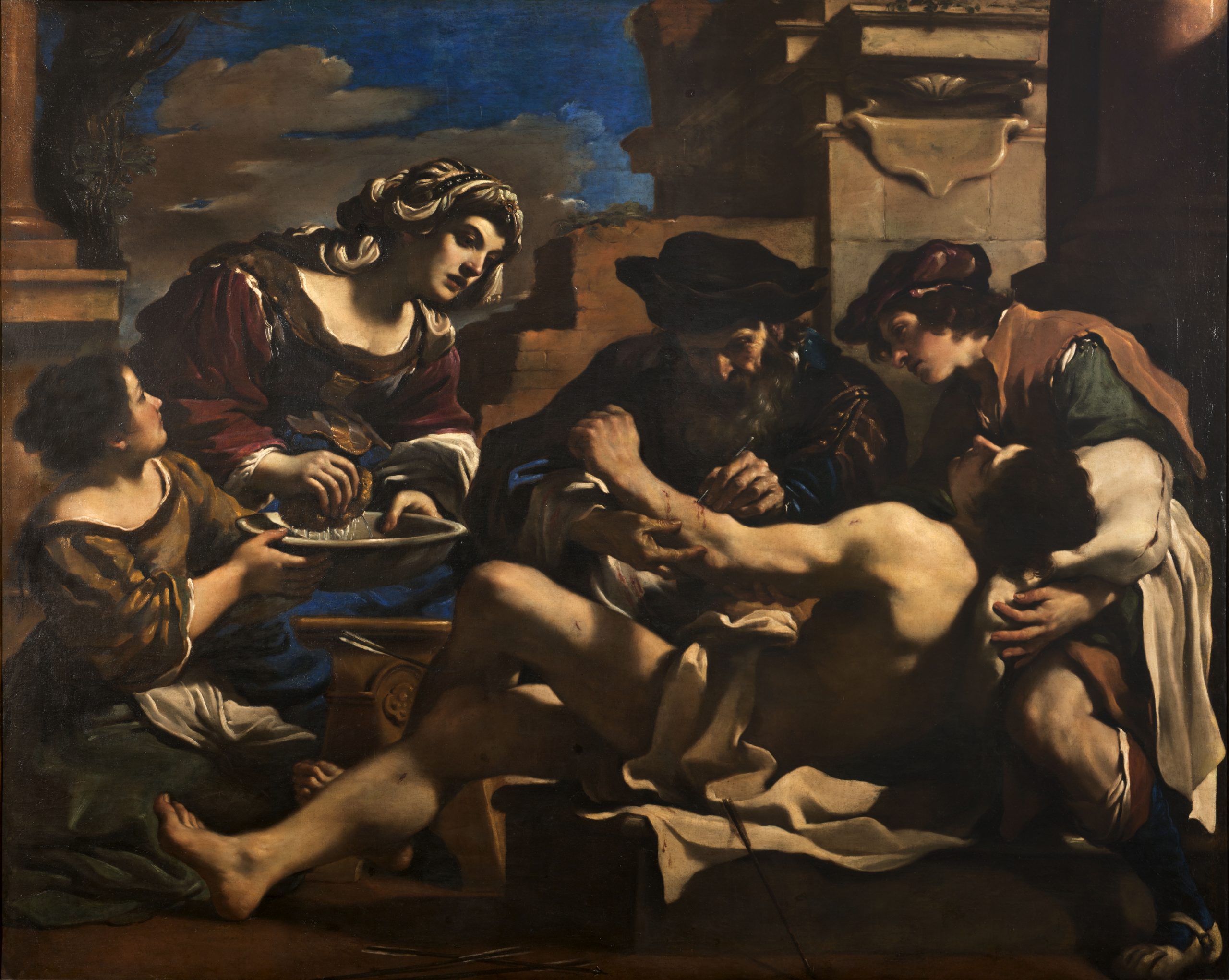
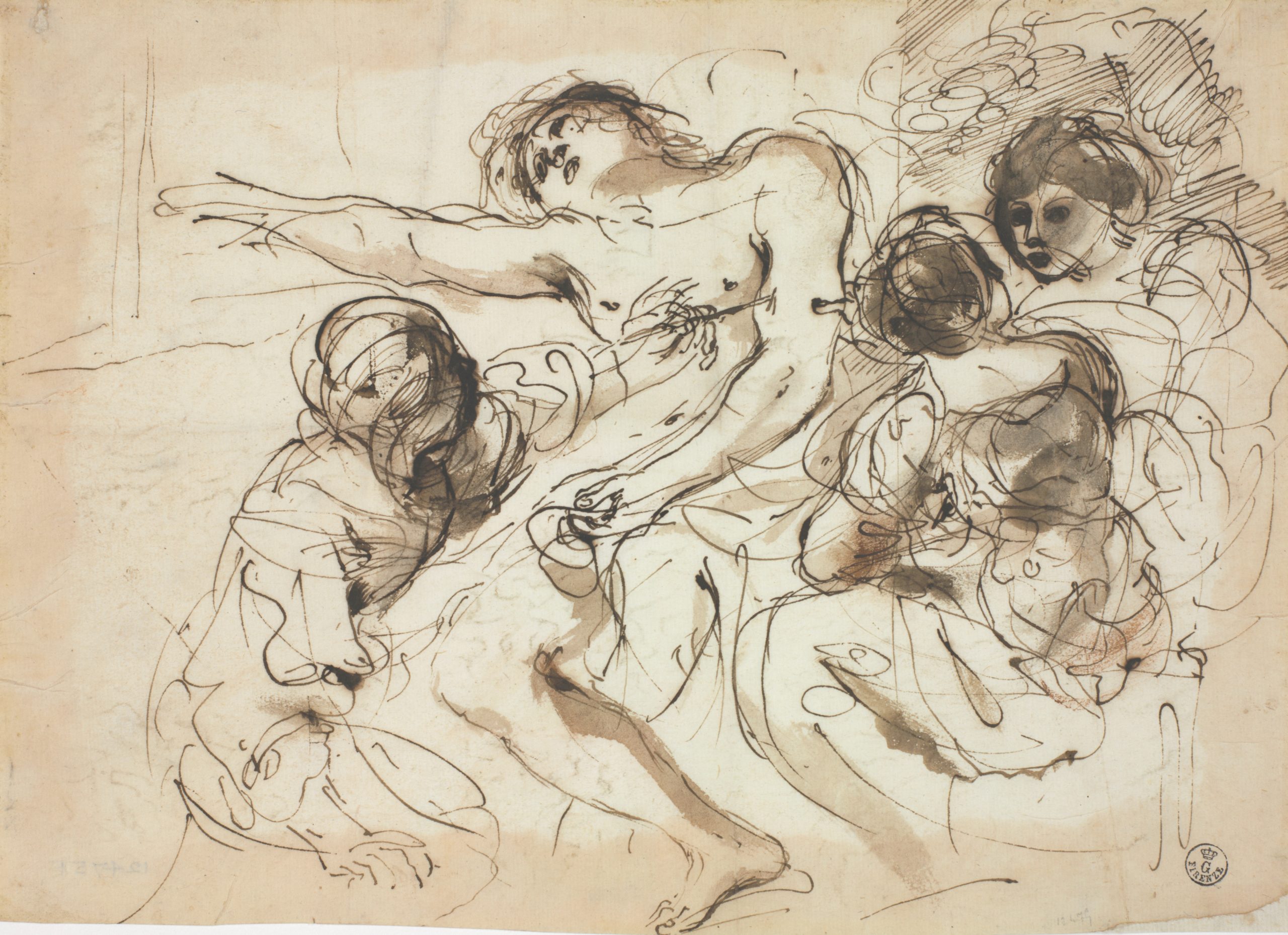
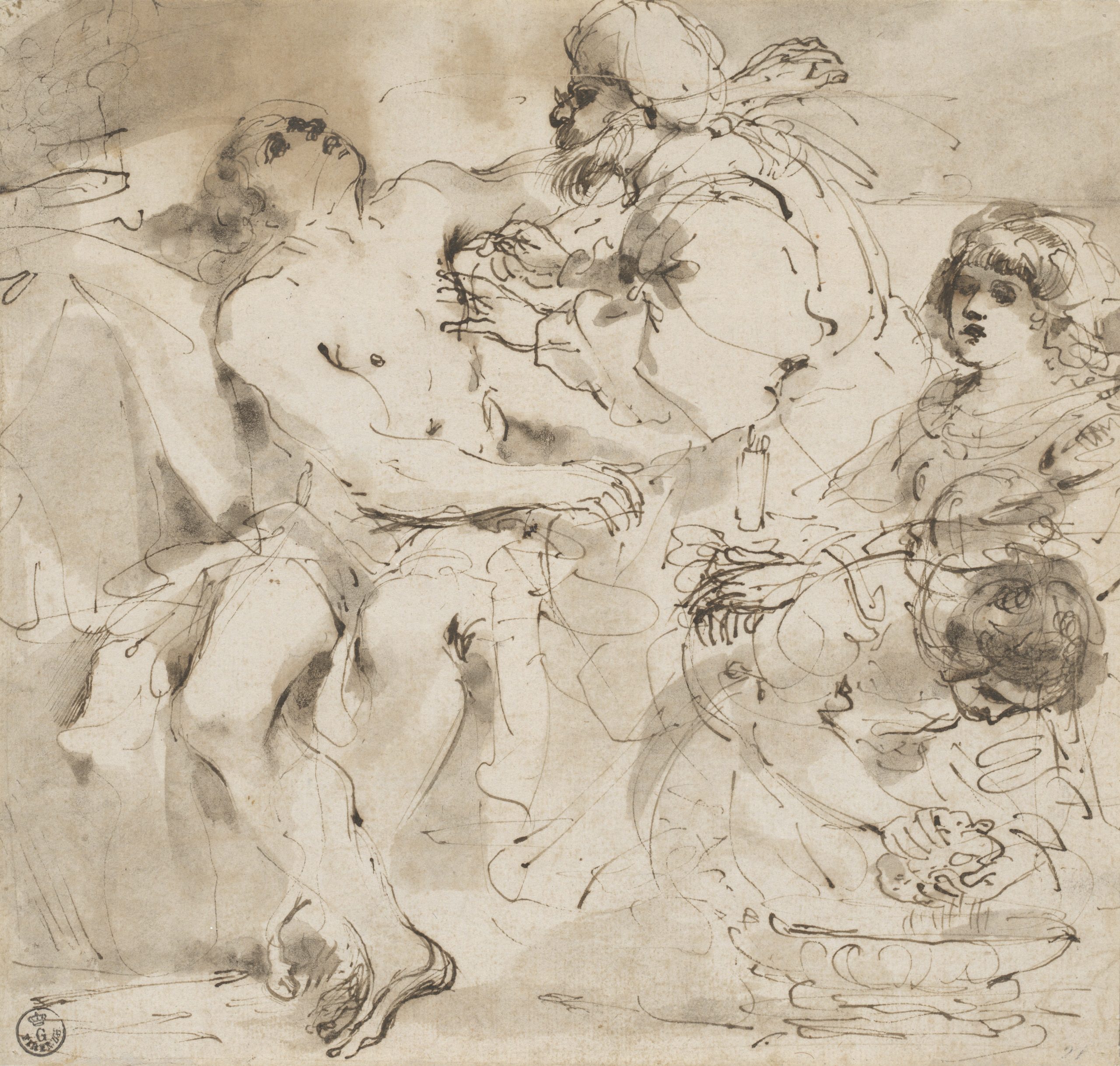
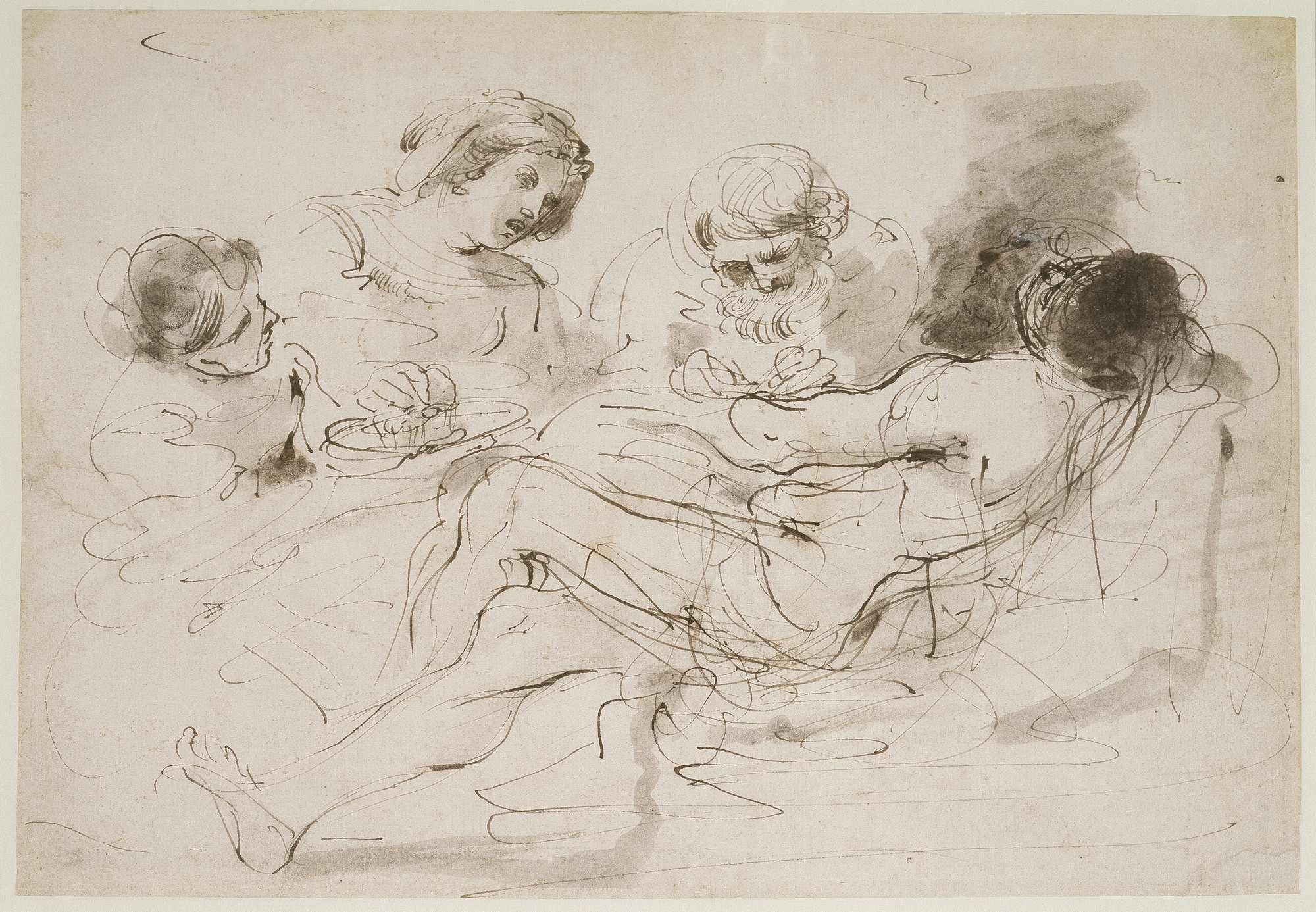
Per il San Sebastiano soccorso esistono tre disegni preparatori: nel foglio a china agli Uffizi (inv. 12475F) san Sebastiano è assistito dalla sola Irene, che gli estrae la freccia dal petto. In un secondo momento il Guercino pensò a una composizione più complessa e articolata, come si vede nel disegno acquerellato sempre degli Uffizi (inv. 1615F). Qui è la figura del medico a soccorrere il santo, mentre Irene guarda lo spettatore porgendo le bende per i medicamenti e la giovane ancella si piega verso il bacile per strizzare la spugna. Solo più tardi, nello sketch oggi alla Royal Library di Windsor (inv. RCIN 902468), l’artista progettò la soluzione definitiva.

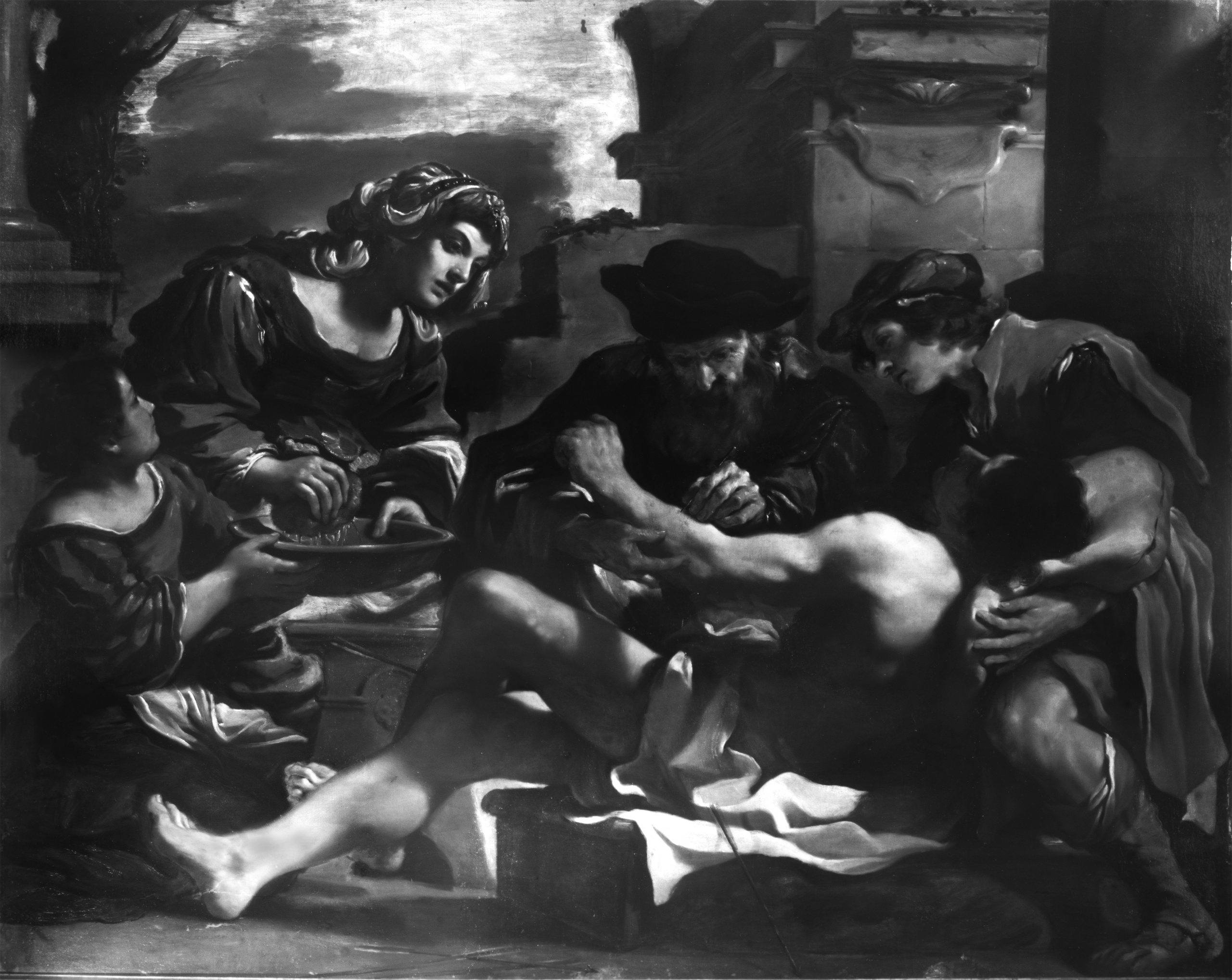
Look for corrections, afterthoughts and regrets in the main IR image on your left.
The modus operandi of Barbieri is mainly based on a direct drafting of color, almost abandoning the technique of preparatory drawing, limiting itself to short strokes, thin, not continuous and half dry for the realization of the contours of the face of some of the characters.
A fluid medium brush is, instead, used by Guercino in some steps, to create an artifice aimed at «detaching from the bottom» certain elements, in order to bring them into the foreground, in a sort of three-dimensional treatment. This is the case, for example, of Saint Sebastian’s knee and legs.
In order to obtain a correct geometric setting of the architectural elements, Guercino draws continuous lines in half dry and without uncertainties that testify to the use of line and/or team, visible in the architecture in the background.
There are small corrections, shots and modest repositioning performed in order to respond to its own aesthetic perception or greater anatomical accuracy. This is evident in the correction of the stool and in the reworking of the saint’s knee.
A second type of rethinking, on the other hand, has deeper motivations, which often involve covering with white and black smoke, and the subsequent replacement of finished pictorial passages with secondary elements or with real design changes. It is the case of the cover of one of the branches of the tree in the upper left corner with a cloud.
The electromagnetic radiation that our eye can detect falls within a range of wavelengths, (“visible light”), from about 400 to 750 nanometers. Beyond these limits, the radiation becomes invisible to humans, but it still can interact in various ways with matter, e.g., through absorption, reflection, transmission, similar to what happens with visible light.
Infrared reflectography is an image acquisition technique that exploits the ability of infrared radiation (wavelength of near-infrared radiation 800-1000 nanometres) to penetrate below the surface of paint and visualize compositional paint changes. By taking advantage of this property, it is possible to observe – where present- preparatory sketches underneath the pictorial layer or to reveal pentimentos (afterthoughts, regrets) or to study changes made by the artist. The images that can be obtained are greyscale, where the lightest areas are those with chemical-physical characteristics that reflect infrared radiation either to a larger extent or completely. The sensitivity of the analysis depends not only on the chemical nature of the paint layers but also on their thickness. Infrared reflectography is pivotal in order to study the painter’s technique and the ‘idea’ at the origin of the painting: it is possible to observe elements that are not visible to the naked eye and to provide information on the evolution of the composition and construction methods of the artwork.