


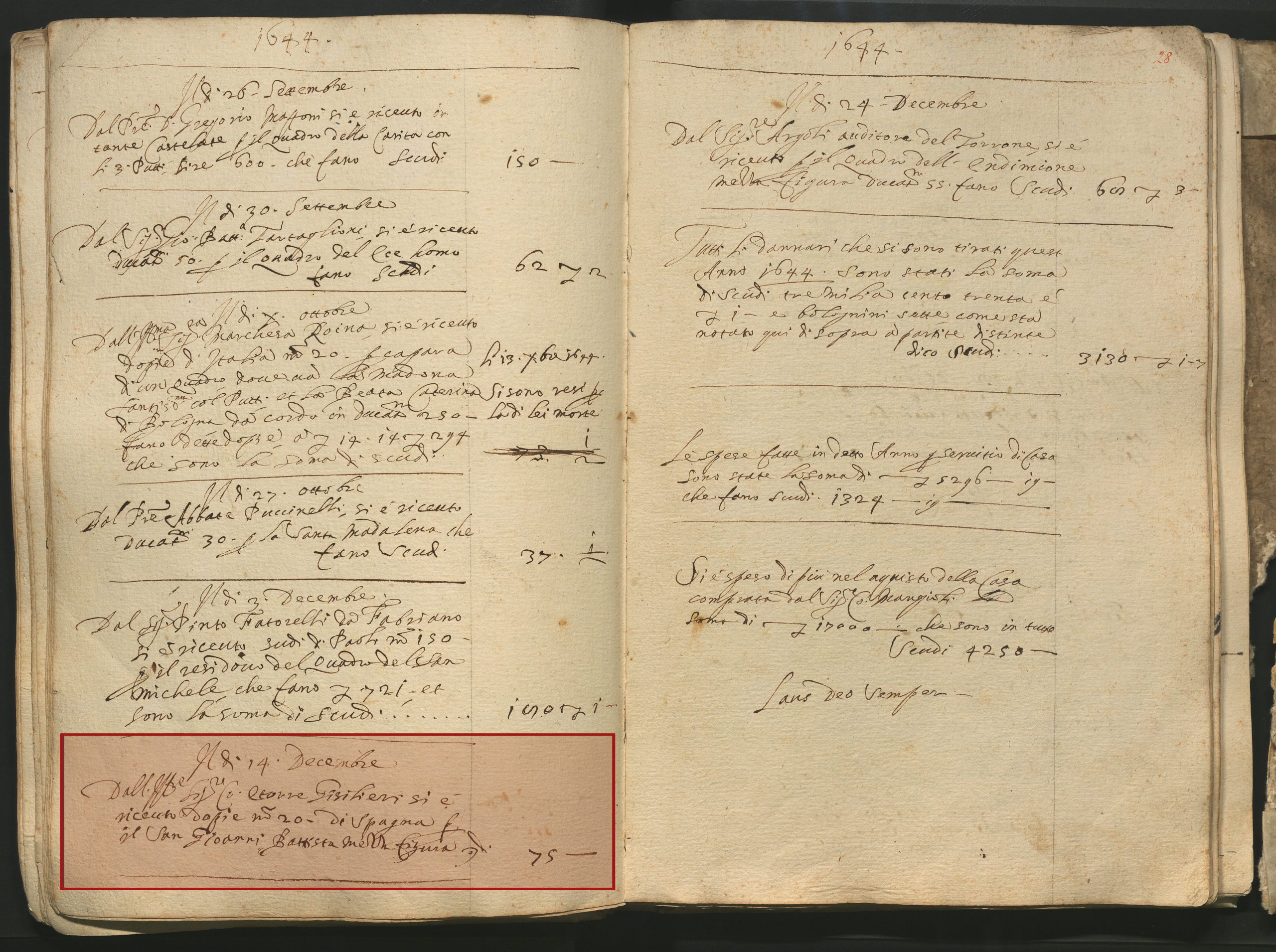
Having assumed control of the workshop that had belonged to Benedetto Gennari senior, Guercino and his brother Paolo Antonio conformed to the rules of the Guild of painters of Bologna, which required art workshops to use proper accounting tools.
Having become the owners of the studio that once belonged to Benedetto Gennari, Guercino and his brother Paolo Antonio joined the Guild of painters of Bologna and started keeping a precise Account book, as was required of all of the Guild’s members.
From 1629 Paolo Antonio began to compile the Book of Accounts, an essential support for the management of the economic affairs of the family and the workshop, where both the money collected for paintings and the expenses incurred for the maintenance of the house and family were recorded.
Paolo Antonio started keeping the Account book in 1629, which proved to be essential in managing the finances of his family and of the studio, and contained information about the proceeds of the paintings, as well as their living and household expenses.
During the twenty years that he was in charge of the Book of Accounts, entries about individual paintings-from their format, to the cost of the work, to news about intermediaries and patrons- were noted with order and regularity. After Paolo Antonio’s death in 1649, his painstaking compilation was succeeded by the more hasty compilation of Guercino, who was to be succeeded, starting in 1665, by his nephew Benedetto Gennari, who was able to manage this fundamental accounting tool with more precision and efficiency.
He updated the Account book regularly and with great care until his death in 1649, adding entries and annotations to the paintings, including their cost and dimensions, as well as information about clients and intermediaries. This task was then assigned to Guercino, who carried it out with less precision; after him, starting from 1665, Benedetto Gennari II undertook the task and kept the Account book updated more efficiently.
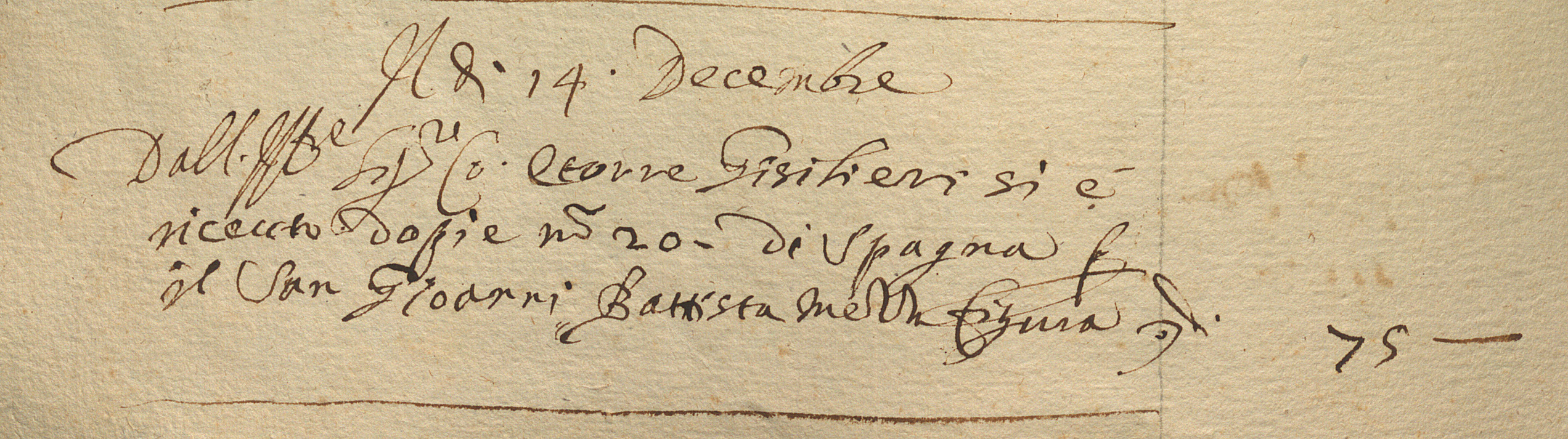
GUERCINO, Libro dei conti, ms., Bologna, Biblioteca comunale dell’Archiginnasio, B 331, c 27v
Libro dei Conti (ed. Ghelfi 1997), p. 123, no. 321.
Il di 14. Dicembre
Dall’Ill. Sig. Co. Etorre Gisilieri si è ricevuto dopie n. 20 di Spagna per il San Giovanni Battista mezza figura Sdi 75